

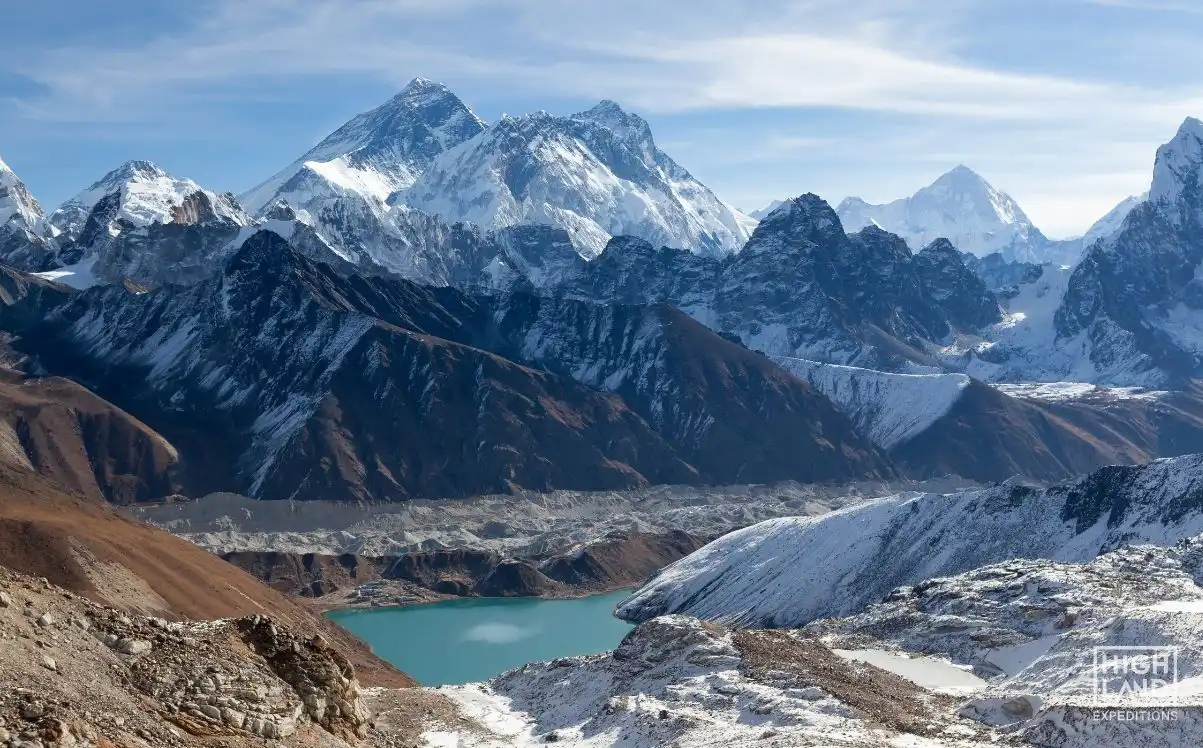
The Everest region is one of Nepal’s most well-known trekking destinations. Trekkers come here for the high-altitude scenery, the Sherpa villages, and the trails that pass through the shadow of the world’s highest mountain.
When planning a trek in this area, two routes are most common: the Everest Base Camp Trek and the Gokyo Lakes Trek. Both start with a flight to Lukla and continue north along the Dudh Koshi Valley through Phakding and Namche Bazaar. Most itineraries include a rest day at Namche, which sits at 3,440 meters, to allow the body to acclimate before going higher.
After Namche, the two routes diverge. The Everest Base Camp route continues northeast toward the Khumbu Glacier, passing through Tengboche, Dingboche, and Lobuche before reaching base camp at 5,364 meters. The Gokyo route turns northwest into a less busy valley, passes glacial lakes, crosses Renjo La Pass at 5,360 meters, and returns to Namche through Thame.
In practical terms, the Gokyo route sees far fewer trekkers on the trail. The trails are less crowded, and the pace feels more relaxed. The Everest Base Camp route is more commercialized and thus sees more people on the trail. Both routes require the same level of physical preparation and the same attention to acclimatization.
Highland Expeditions is a trekking company based in Kathmandu. We have been running trips in the Everest region for years and know both routes well. Our itineraries are built around safe acclimatization schedules, and our guides are experienced in recognizing altitude-related issues before they become serious problems.
Table of Contents
The Everest Region: Where Every Trail Leads to Something Extraordinary
The Everest region, also known as the Khumbu, is one of Nepal’s most established trekking areas. It is home to well-marked trails, experienced local guides, and a strong network of tea houses that support trekkers throughout the season.
From both the Everest Base Camp and Gokyo Lakes routes, trekkers can see major peaks such as Mount Everest, Lhotse, Ama Dablam, and Cho Oyu. The journey also passes through traditional Sherpa villages, Buddhist monasteries, and high-altitude settlements inside Sagarmatha National Park, a UNESCO World Heritage Site.
Highland Expeditions organizes carefully structured Everest region treks with proper acclimatization days and clear daily plans. Our Everest region trekking packages include the following routes:
Everest Base Camp Trek: Walking Toward the World’s Highest Mountain
Everest Base Camp trek follows the classic route in the Khumbu region, starting with the flight from Kathmandu to Lukla. From Lukla, the trail passes through Phakding and continues toward Namche Bazaar before moving deeper into the high mountains.
The route is well established and supported by teahouses along the way. At Highland Expeditions, our team has built proper acclimatization days into the itinerary to help trekkers adjust safely to increasing altitude.
The Route That has Inspired Trekkers for Decades
The journey from Lukla to Everest Base Camp has steady elevation gain and planned rest stops. Key locations such as Namche Bazaar, Tengboche, Dingboche, and Gorakshep play an important role in both acclimatization and overnight stays.
Namche Bazaar is the main trading hub of the region and the usual first acclimatization stop. From there, the trail continues to Tengboche, known for its monastery and mountain views, before reaching Dingboche for further altitude adjustment. The final section leads to Gorakshep, the last settlement before Everest Base Camp.
Highlights That Define the Everest Base Camp Experience
- Standing at Everest Base Camp gives you a close view of the Khumbu Icefall and the expedition environment during climbing seasons.
- Sunrise from Kala Patthar offers one of the clearest and most reliable views of Mount Everest.
- Namche Bazaar serves as the main acclimatization stop and the commercial center of the Khumbu region.
- Tengboche Monastery provides both cultural insight and wide mountain views along the trekking route.
- Views of the Khumbu Glacier and surrounding peaks include impressive sights of Ama Dablam, Lhotse, and Nuptse throughout the journey.
Gokyo Lakes Trek: Discovering a Quieter Side of the Everest Region
The Gokyo Lakes Trek explores the western side of the Everest region through the Gokyo Valley. The route offers a less-travelled alternative to the classic trail and includes a high-altitude mountain pass.
This journey features glacial lakes, open valleys, and wide mountain views that differ from the standard Everest Base Camp route. The trail also offers a varied landscape, especially after crossing Renjo Pass.
A Scenic Alternative That Reveals Hidden Valleys and Glacial Lakes
The Gokyo Valley is quieter than the main Everest Base Camp trail. As you walk further into the valley, the landscape opens up and the crowds thin out. The route passes a series of high-altitude lakes before climbing to Renjo La Pass, which connects the Gokyo side to the Thame Valley.
The Gokyo system has six main glacial lakes. Here is a brief overview of each one:
- Gokyo Cho (Dudh Pokhari): This is the most well-known lake in the valley and sits right next to Gokyo village. It is large, deep blue-green in color, and reflects the surrounding peaks on calm days.
- Thonak Cho: Located just north of Gokyo village, this is actually the largest lake in the entire Gokyo system by surface area. It is less photographed than Gokyo Cho but is worth the short walk.
- Ngozumpa Cho: This lake lies near the Ngozumpa Glacier, the longest glacier in Nepal. The glacial landscape around it is raw and wide open.
- Taujung Cho: A smaller lake further up the valley. It is quieter and sees fewer visitors, but the high-altitude setting is striking.
- Gyazumpa Cho: Another lake in the upper part of the chain. Like the others, it is fed by glacial melt and surrounded by rocky terrain and peaks.
- Longpongo: This is one of the lower lakes in the series. Trekkers pass it earlier in the valley walk before reaching the more famous upper lakes.
Why is this itinerary special?
This is the only Gokyo Lakes package we currently offer, and it is built to cover both the lakes and the pass in one trip. Most treks in this area either visit Gokyo or cross a high pass, but not both together. Combining the two makes the route more complete and gives trekkers a better sense of the wider region.
Instead of walking back the same way from Gokyo, this itinerary crosses Renjo La and descends into the Thame Valley. This loop means you see two different sides of the Everest region on a single trek.
Highlights of the Gokyo Lakes and Renjo Pass Trek
- The turquoise Gokyo Lakes provide a unique high-altitude lake system surrounded by Himalayan peaks.
- Panoramic views from Gokyo Ri include Mount Everest and several major peaks in the region.
- The Renjo Pass crossing offers wide mountain scenery and connects two different valleys.
- The quiet villages of the Thame Valley add cultural depth and a less crowded trekking experience.

Everest Base Camp vs Gokyo Lakes and Renjo Pass: A Quick Comparison
Here’s a table of comparison between Everest Base Camp Gokyo lakes and Renjo Pass:
| Feature | Everest Base Camp Trek | Gokyo Lakes Trek |
|---|---|---|
| Main Highlights | This trek focuses on reaching Everest Base Camp and hiking to Kala Patthar for a close view of Mount Everest. | This trek highlights the Gokyo Lakes, the viewpoint of Gokyo Ri, and the crossing of Renjo Pass for wide mountain views. |
| Trek Style | The route follows the same path going up and coming back down. | The route follows a circular path and continues through the Thame Valley instead of returning the same way. |
| Crowd Level | This is one of the most popular trekking routes in Nepal and can be busy during peak seasons. | This route is generally quieter after Namche Bazaar and has fewer trekkers on the trail. |
| Landscapes | The trail includes glacier areas, rocky paths, suspension bridges, and close views of mountain camps near Everest. | The trail includes high-altitude lakes, open valleys, and wide views of many Himalayan peaks. |
| Highest Point | The highest point is Kala Patthar at 5,545 meters, which offers one of the best views of Mount Everest. | The highest point is Gokyo Ri at 5,360 meters, which offers one of the best views of Gokyo Lakes with Everest |
| Duration | The standard itinerary takes about 16 days, including travel and acclimatization days. | The standard itinerary takes about 16 days, including travel and acclimatization days. |
| Difficulty Level | The trek is moderately challenging because of long walking days and high altitude. | The trek is also moderately challenging, with an added long day when crossing Renjo Pass. |
| Route Experience | Trekkers follow the same trail both ways, which makes the journey more straightforward. | Trekkers follow an anticlockwise route with Gokyo and Renjo Pass. |
| Acclimatization Plan | The trek includes rest days in Namche Bazaar and Dingboche to help the body adjust to higher altitude. | The trek includes acclimatization stops in Namche, Machhermo, and Gokyo before crossing Renjo Pass. |
| Ideal For | This trek is suitable for trekkers who want to reach the famous base of Mount Everest for the first time. | This trek is suitable for trekkers who prefer quieter trails and more varied mountain views. |
How do the Visual Experiences Differ on These Two Everest Region Treks?
Everest Base Camp: Glaciers and Mountain Walls
The Khumbu Glacier is one of the first big things you notice on the Everest Base Camp trek. You start seeing it clearly around Lobuche and Gorakshep. From there, the trail leads to Everest Base Camp at 5,364 meters, which sits right at the foot of the Khumbu Icefall. During trekking season, climbing teams are active on the Icefall, and you can watch them from below.
Past Dingboche, the land starts to open up. It gets rocky and feels more raw. The peaks around you, Nuptse, Lhotse, and Pumori, rise steeply and surround the valley like walls. It can feel a little closed in, but in a powerful way.
The best viewpoint on this route is Kala Patthar at 5,545 meters. From up there, you get a clear look at Everest along with Lhotse, Nuptse, and the ridgelines nearby. The whole scene feels close and vertical. Above 4,500 meters, the days are physically tough, so pacing yourself well is important.
Gokyo Lakes: Glacial Lakes, Open Valleys, and Wide Mountain Views
The Gokyo trek has a completely different feel. The landscape here is wide and open, built around a chain of high-altitude lakes in the Gokyo Valley. The main one is Gokyo Lake, also called Dudh Pokhari. These lakes lie beside the Ngozumpa Glacier, Nepal’s largest glacier.
Compared to the Everest Base Camp route, this valley feels less crowded and more peaceful. There are fewer expedition camps, and the open space gives everything a calmer tone. Gokyo Ri at 5,357 meters is the main viewpoint here. On a clear day, you can see Everest, Lhotse, Makalu, and Cho Oyu all at once. It offers one of the widest views of the mountains in the whole region.
Crossing Renjo Pass at around 5,360 meters takes this even further. From the top, you see Everest and the other peaks on one side, the Gokyo Lakes below you, and the Thame Valley on the other side. It is a long day, and you need an early start, but the views make it worth every step.
Why Gokyo Lakes is a Suitable Second Trek in the Everest Region?
If you have already done the Everest Base Camp trek, Gokyo Lakes and Renjo Pass are a great next step in the same region. Both treks start the same way, from Lukla to Namche Bazaar, but split apart after Namche.
From Namche, the Gokyo route heads toward Dole, Machhermo, and Gokyo Village. The Gokyo side has wide valleys and a chain of lakes, while the EBC side is more focused on glaciers and rocky terrain.
The Ngozumpa Glacier is one of the highlights here. It is Nepal’s largest glacier and runs alongside the Gokyo Valley. The Gokyo Lakes, including the main Gokyo Lake, also known as Dudh Pokhari, sit beside this glacier. From Gokyo Ri at 5,357 meters, you can see Everest, Lhotse, Makalu, and Cho Oyu all together on a clear day. That is a wider view than what you get from Kala Patthar on the EBC route.
Crossing Renjo Pass at around 5,360 meters is another thing that makes this trek stand out. From the top, you look out over Everest, Lhotse, and the Gokyo Lakes behind you, and the Thame Valley ahead. It is a long day, so starting early and keeping a steady pace are important.
Final Thoughts: Two Incredible Ways to Experience the Everest Region
The Everest region gives you two very different treks, but both will leave you with a strong connection to the mountains, the local culture, and the high-altitude landscape.
If you want a classic route with well-known stops and a direct path to Everest Base Camp, that trek is straightforward and well-supported all the way through. If you want more variety, quieter trails in the upper sections, and a route that loops through different valleys, then Gokyo Lakes and Renjo Pass is the better fit.
If you have time and wish to do both the Everest Base Camp and the Gokyo Lakes Trek in single trip, then our Everest Base Camp Gokyo Lakes Trek is ideal for you
When you are ready to plan your trip, Highland Expeditions can help you choose the route that suits you best. We look at your experience level, your schedule, and what you want to get out of the journey.

Frequently Asked Questions
Which trek is more difficult: Everest Base Camp or Gokyo Lakes?
Both the Everest Base Camp (EBC) trek and the Gokyo Lakes trek are considered challenging, mainly due to the high altitude rather than technical difficulty, and the overall difficulty depends on the specific itinerary you choose. If you trek to Gokyo Lakes without crossing any high passes, the Everest Base Camp trek is generally slightly more difficult because it involves longer trekking days and a steady ascent. However, if the Gokyo trek includes crossing high passes such as Renjo La (over 5,300 meters), it becomes more demanding than EBC due to steeper climbs, rougher terrain, and more physically intense days. In contrast, the Everest Base Camp route, while still strenuous, follows a more straightforward trail without major high pass crossings, making it less technically demanding but still challenging due to altitude and endurance requirements.
Which trek is less crowded during peak trekking seasons?
The Gokyo Lakes route is usually less crowded than the Everest Base Camp trek during peak trekking seasons. Most trekkers follow the classic EBC trail, so sections like Lukla, Namche Bazaar, and Tengboche can get busy. The Gokyo Valley sees fewer trekkers, offering a quieter and more relaxed trekking experience.
How long does the Everest Base Camp trek take?
Everest Base Camp trek takes around 16 days with a well-planned itinerary. This duration includes your arrival and departure days, travel to Lukla, acclimatization days in places like Namche Bazaar and Dingboche, and the trek to Kala Patthar and Everest Base Camp. The schedule is designed to allow gradual altitude gain and safe acclimatization.
Can beginners attempt these treks?
Yes, beginners can attempt both treks if they prepare properly and follow a structured itinerary. Neither trek requires technical climbing, but trekkers should be comfortable walking several hours a day at high altitude. Good physical preparation and proper acclimatization are important for a safe and enjoyable experience.
If I have already completed Everest Base Camp, should I try the Gokyo Lakes trek next?
Yes, the Gokyo Lakes and Renjo Pass trek is a great next option for those who have already completed the Everest Base Camp. The route is almost entirely different except for the Namche, Phakding, and Lukla section. It allows trekkers to explore new valleys, lakes, and viewpoints within the Everest region.
What is the best time of year to trek in the Everest region?
The best time to trek in the Everest region is during spring (March to May) and autumn (September to November). These seasons typically offer clear skies, stable weather, and excellent mountain visibility. They also provide comfortable temperatures for trekking at high altitudes.
Which trek offers the best views of Mount Everest?
Both treks offer impressive views of Everest, but the Gokyo Lakes and Renjo Pass trek provides wider panoramic perspectives of the surrounding Himalayan range. Viewpoints like Gokyo Ri and Renjo Pass offer views of Everest alongside peaks such as Lhotse, Makalu, and Cho Oyu. The Everest Base Camp trek offers a closer view of Mount Everest from Kala Patthar
Is Renjo Pass difficult to cross?
Yes, Renjo Pass is one of the more demanding sections of the Gokyo Lakes trek. The crossing involves a steep, high-altitude walk and usually requires a full day of trekking. However, with proper acclimatization and a steady pace, it is achievable for prepared trekkers.
Do both treks start with the Lukla flight?
Yes, both the Everest Base Camp and Gokyo Lakes and Renjo Pass treks usually begin with a flight from Kathmandu to Lukla. From Lukla, the trek continues to Phakding and then to Namche Bazaar before the routes diverge. Weather conditions can sometimes affect flights, so trekkers often keep buffer days in their travel plans.

